


 Play Audiobook Sample
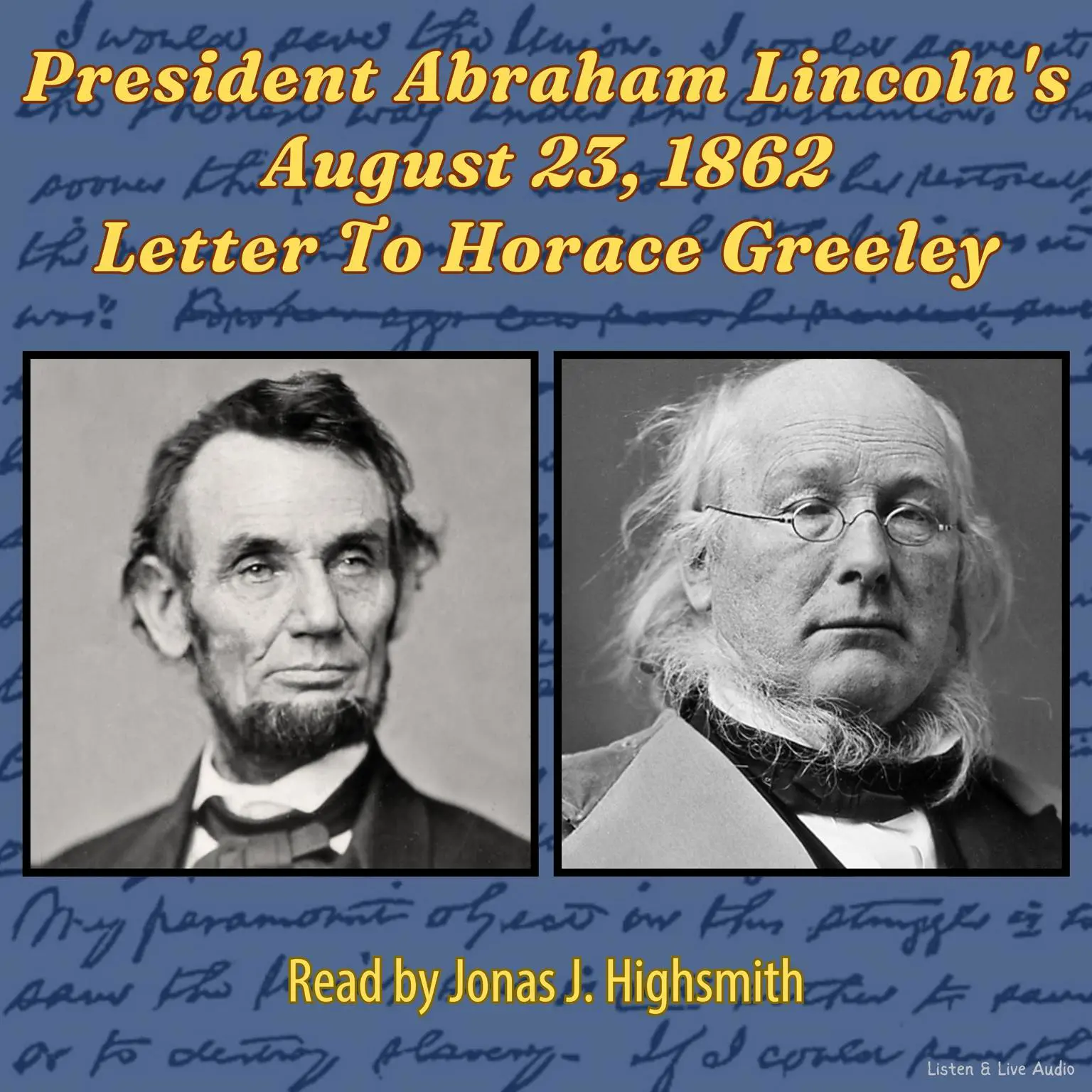
President Abraham Lincoln's August 23, 1862 Letter To Horace Greeley Audiobook
Play Audiobook Sample
 (0.00) - 0 listener ratings
Quick Stats About this Audiobook
Total Audiobook Chapters:
Longest Chapter Length:
Shortest Chapter Length:
Average Chapter Length:
Audiobooks by this Author:




Publisher Description
Horace Greeley (1811–1872) was the founder and editor of the influential New York Tribune, whose circulation was among the largest in the United States. On August 19, 1862, Greeley wrote an editorial titled “The Prayer of Twenty Millions”--referring to the number of Northerners loyal to the Union--which criticized Lincoln for his reluctance to use the powers Congress had given him to confiscate southern property, including slaves, in order to emancipate them. The following is President Abraham Lincoln's reply, published in the Daily National Intelligencer on August 23, 1862.
Honorable Horace Greeley,
Dear Sir:
I have just read yours of the 19th, addressed to myself through the New York Tribune. If there be in it any statements, or assumptions of fact, which I may know to be erroneous, I do not now and here controvert them. If there be in it any inferences which I may believe to be falsely drawn, I do not now and here argue against them. If there be perceptible in it an impatient and dictatorial tone, I waive it in deference to an old friend whose heart I have always supposed to be right.
As to the policy I “seem to be pursuing,” as you say, I have not meant to leave anyone in doubt.
I would save the Union. I would save it the shortest way under the Constitution. The sooner the national authority can be restored the nearer the Union will be “the Union as it was.” If there be those who would not save the Union unless they could at the same time save slavery, I do not agree with them. If there be those who would not save the Union unless they could at the same time destroy slavery, I do not agree with them.
My paramount object in this struggle is to save the Union, and is not either to save or to destroy slavery. If I could save the Union without freeing any slave I would do it, and if I could save it by freeing all the slaves I would do it; and if I could save it by freeing some and leaving others alone, I would also do that. What I do about slavery and the colored race, I do because I believe it helps to save this Union; and what I forbear, I forbear because I do not believe it would help to save the Union.
I shall do less whenever I shall believe what I am doing hurts the cause, and I shall do more whenever I shall believe doing more will help the cause. I shall try to correct errors when shown to be errors; and I shall adopt new views so fast as they shall appear to be true views.
I have here stated my purpose according to my view of official duty; and I intend no modification of my oft-expressed personal wish that all men everywhere could be free.
Yours, A. Lincoln
Download and start listening now!
President Abraham Lincoln's August 23, 1862 Letter To Horace Greeley Listener Reviews
Be the first to write a review about this audiobook!
About Abraham Lincoln
Abraham Lincoln (1809–1865) was the sixteenth president of the United States, serving from March 1861 until his assassination in April 1865. He led the US through its greatest constitutional, military, and moral crises—the American Civil War—preserving the Union, abolishing slavery, strengthening the national government, and modernizing the economy. Reared in a poor family in rural Indiana, he was a self-educated man. In the 1830s he became a country lawyer, a Whig Party leader, and Illinois state legislator. He later served as a one-term member of the House of Representatives during the 1840s.