


 Play Audiobook Sample
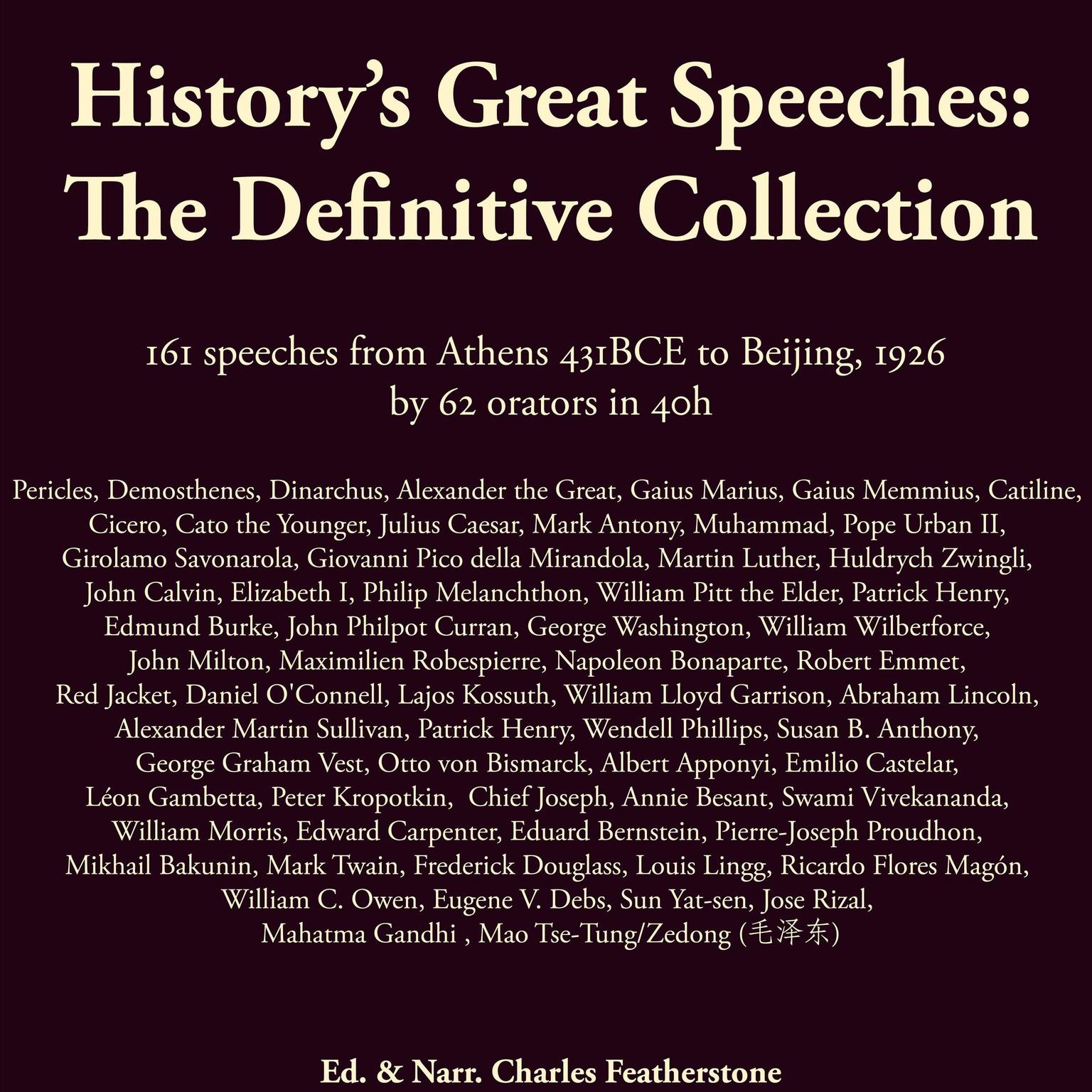
History's Great Speeches: The Definitive Collection: 161 speeches from Athens 431BCE to Beijing, 1926 by 62 orators in 40h Audiobook
Play Audiobook Sample
 (0.00) - 0 listener ratings
Quick Stats About this Audiobook
Total Audiobook Chapters:
Longest Chapter Length:
Shortest Chapter Length:
Average Chapter Length:
Audiobooks by this Author:


Publisher Description
Embark on a journey through 2,400 years of history with this definitive collection of 161 of the world’s greatest speeches. Presented chronologically, this master volume spans from the golden age of Athens in 431BCE to the dawn of a new China in 1926, now complete with seminal speeches from India’s Mohandas Gandhi and China’s Mao Tse-Tung.
The collection begins with Demosthenes, whose rhetorical mastery forms the DNA of modern expression. Witness the high point of the Athenian empire with Pericles’ funeral oration and hear the only known speech of Julius Caesar before the Roman senate. Delve into the Roman Civil War, dominated by the rivalry between the revolutionary Cataline and the great statesman Cicero, and feel the power of Mark Antony’s oration over Caesar’s body.
After a millennium where rhetoric waned, the art is reborn with Mirandola’s "Oration on the Dignity of Man," firing the starting pistol for the Renaissance. The Reformation erupts with Martin Luther’s barnstorming 95 Theses, while the Enlightenment gives way to political upheaval. Hear Maximillien Robespierre’s chilling justifications for terror, Patrick Henry’s cry for liberty, and Napoleon Bonaparte’s revolutionary addresses.
Explore the great debates of the 19th century: the struggle against slavery, the rise of anarchism with Pierre-Joseph Proudhon, Otto von Bismarck’s “Blood and Iron” forging a new nation, and Abraham Lincoln’s immortal words. Witness the birth of socialism, the powerful anti-war arguments of Eugene Debs, and Swami Vivekananda’s address bridging East and West.
This complete volume concludes with visionary speakers from Mexico, the Philippines, India, and China, whose words shaped the modern world and continue to resonate into the twenty-first century.
Download and start listening now!
History's Great Speeches Listener Reviews
Be the first to write a review about this audiobook!
About the Authors
John Milton (1608–1674) is considered to be among the most learned of all English poets. After graduating from Cambridge, Milton undertook six years of self-directed study in theology, philosophy, history, politics, literature, and science. He then spent several years writing pamphlets for the Puritan and Parliamentary causes. His incessant labors setting the typeface eventually led to blindness. His masterpiece, Paradise Lost, was composed in memory and dictated to a scribe.
Julius Caesar (100 BC–44 BC) was a military general and leading politician in the Roman republic. His family, the Julii, claimed descent from the ancient kings of Rome and from the goddess Venus. Caesar rapidly carved out an impressive political career, forging an alliance with Pompey and Crassus in 60 BC. The Civil War is Caesar’s attempt at an explanation of the war that changed the Roman world.
Frederick Douglass (1818–1895), né Frederick Augustus Washington Bailey, was born into slavery in Maryland. Upon successfully escaping slavery—on his third attempt—in 1838, Douglass became one of the key leaders of the abolitionist movement in the United States. An extremely gifted orator, he repeatedly risked his own freedom as an antislavery speaker, writer, and statesman. A firm believer in equality for all people, including Native Americans, women, and immigrants, Douglass was also an activist in the women’s suffrage movement. He died in Washington DC, shortly after he attended a meeting of the National Council of Women, where he had received a standing ovation for his enormous contribution to human rights.
Marcus Tullius Cicero (106–43 BC), commonly known as Cicero, was a Roman statesman, philosopher, orator, and lawyer. Born into an aristocratic family, he studied law and served a term as consul in 63 BC. Following the assassination of Caesar in 44 BC, to which he was a witness, he argued in front of the senate for the restoration of the republic but was unsuccessful. In 43 BC, he was murdered on the orders of Mark Antony. Cicero’s works include philosophic writings, speeches made as a lawyer and a senator, and letters.
Martin Luther (1483–1546) was a German scholar, priest, theologian, and religious reformer and is considered one of the chief figures in European history. Arguing that money couldn’t buy freedom from God’s punishment for one’s sins, he laid the foundation for Protestant Reformation and greatly influenced the fields of politics, religion, education, and economics through his work and writings.
Mark Twain (1835–1910) was born Samuel L. Clemens in the town of Florida, Missouri. He is one of the most popular and influential authors our nation has ever produced, and his keen wit and incisive satire earned him praise from both critics and peers. He has been called not only the greatest humorist of his age but also the father of American literature.
John Calvin (1509–1564) was a French Protestant theologian during the Protestant Reformation and a central developer of the system of Christian theology called Calvinism, or Reformed theology. In Geneva he rejected the authority of the Pope, established a new scheme of civic and church governance, and created a central hub from which Reformed theology was propagated. He is renowned for his teachings and writings.
Abraham Lincoln (1809–1865) was the sixteenth president of the United States, serving from March 1861 until his assassination in April 1865. He led the US through its greatest constitutional, military, and moral crises—the American Civil War—preserving the Union, abolishing slavery, strengthening the national government, and modernizing the economy. Reared in a poor family in rural Indiana, he was a self-educated man. In the 1830s he became a country lawyer, a Whig Party leader, and Illinois state legislator. He later served as a one-term member of the House of Representatives during the 1840s.
Edmund Burke (1729–1797) became a member of Parliament in 1765. He championed the unpopular cause of Catholic emancipation and a great part of his career became dedicated to the problem of India. The French Revolution prompted one of his best-known works, Reflections on the Revolution in France.
Lao Tzu was a philosopher of ancient China, best known as the author of the Tao Te Ching.
William Morris (1834–1896) was an English textile designer, poet, novelist, translator, and social activist. Associated with the British Arts and Crafts Movement, he was a major contributor to the revival of traditional British textile arts and methods of production. His literary contributions helped to establish the modern fantasy genre, while he played a significant role in propagating the early socialist movement in Britain.
Jacques Roy is a audio narrator and actor, known for The Lower Angels and Room and Board.