


 Play Audiobook Sample
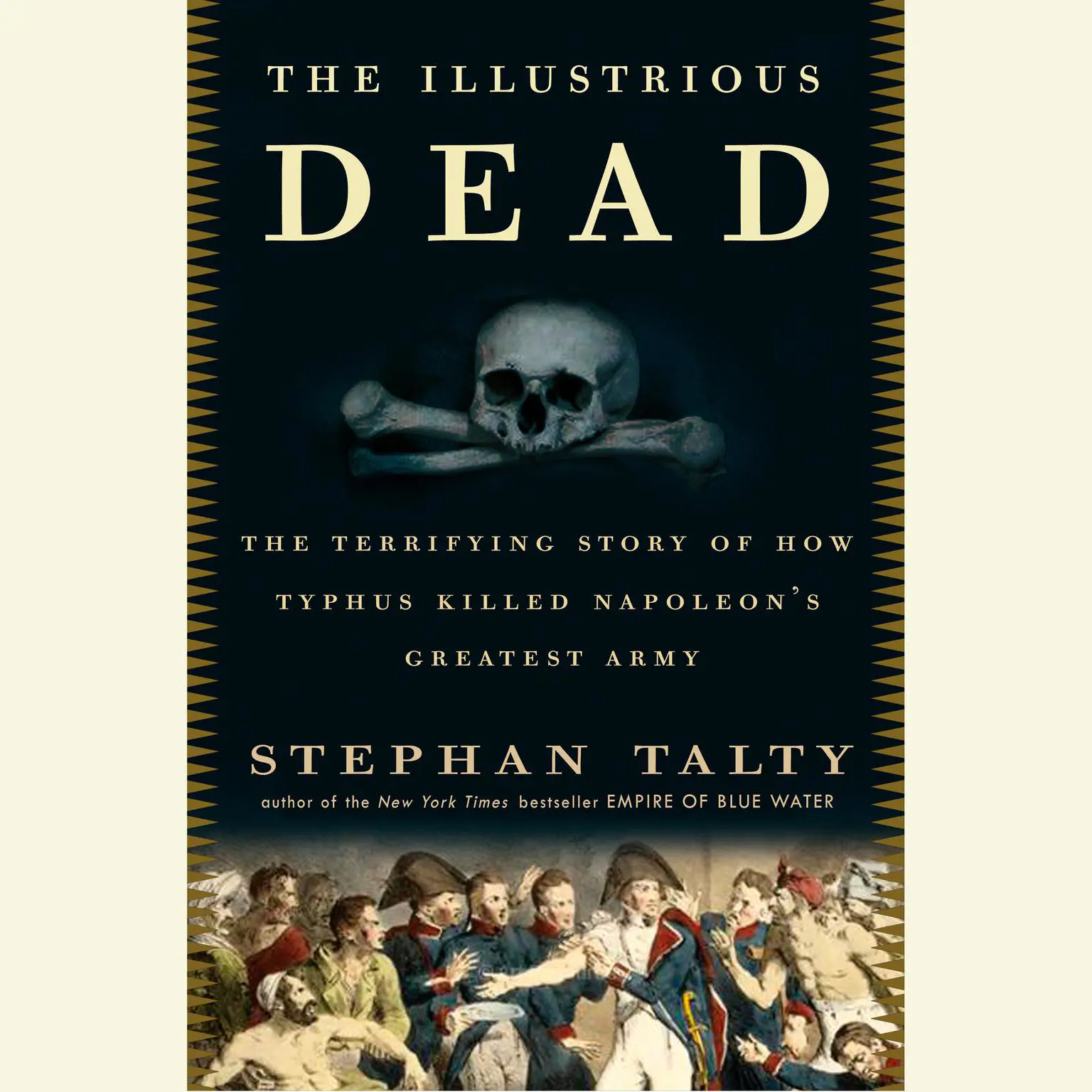
The Illustrious Dead: The Terrifying Story of How Typhus Killed Napoleon's Greatest Army Audiobook
Play Audiobook Sample


 (3.07) - 224 listener ratings
Quick Stats About this Audiobook
Total Audiobook Chapters:
Longest Chapter Length:
Shortest Chapter Length:
Average Chapter Length:
Audiobooks by this Author:


Publisher Description
A masterful dual narrative of Napoleon Bonaparte and a tiny microbe that pits the height of human ambition and achievement against the supremacy of nature, from the New York Times bestselling author of Empire of Blue Water
“Gripping . . . Talty brings international politics and science together in a compelling story of personal hubris and humbling defeat.”—Jack Weatherford, author of the New York Times bestseller Genghis Khan and the Making of the Modern World
In the spring of 1812, Napoleon Bonaparte was at the height of his powers. Forty-five million called him emperor, and he commanded a nation that was the richest, most cultured, and advanced on earth. No army could stand against his impeccably trained, brilliantly led forces, and his continued sweep across Europe seemed inevitable.
Early that year, bolstered by his successes, Napoleon turned his attentions toward Moscow, helming the largest invasion in human history. Surely, Tsar Alexander’s outnumbered troops would crumble against this mighty force. But another powerful and ancient enemy awaited Napoleon’s men in the Russian steppes. Virulent and swift, this microscopic foe would bring the emperor’s progress to a halt. Even as the Russians retreated before him in disarray, Napoleon found his army disappearing, his frantic doctors powerless to explain what had struck down a hundred thousand soldiers.
The Illustrious Dead delves deep into the origins of the pathogen that finally ended the mighty emperor’s dreams of world conquest and exposes this “war plague’s” hidden role throughout history. A tale of two unstoppable forces meeting on the road to Moscow in an epic clash of killer microbe and peerless army, The Illustrious Dead is a historical whodunit in which a million lives hang in the balance.
Download and start listening now!
"I really enjoyed this book. Gives the geopolitical environment of 19th century Europe, traces Napoleon's rise, various other key figures roles, and follows Napoleon from France to Russia and back again with the little microbe that torpedoed his Russian adventure. At the same time, 19th century medicine/theory is explained, the history of typhus and its relationship with war, and its effects are all detailed. "Terrifying" indeed."
— Josh (4 out of 5 stars)
Quotes
-
An eloquent and vivid portrait that includes a view through the telescopes of rear-echelon commanders, the rifle sights of front-line skirmishers, and the clouded spectacles of field surgeons laboring in candlelit abattoirs . . . the finest kind of popular history.
— William Rosen, author of Justinian’s Flea: The First Great Plague and the End of the Roman Empire -
A swashbuckling adventure . . . [the] characters leap to life.
— The New York Times Book Review -
Reeking of authentic blood and thunder, and as richly detailed as a work of fiction . . . dramatically evokes the rough and tumble age when pirates owned the seas. A thrilling and fascinating adventure.
— Caroline Alexander, author of The Endurance -
Stephan Talty’s vigorous history of seventeenth-century pirates of the Caribbean will sate even fickle Jack Sparrow fans. A pleasure to read from bow to stern.
— Entertainment Weekly -
Serves up swashbuckling history at its briny, blood-soaked best, with enough violence and passion to keep the pages flying by.
— Tom Reiss, author of The Orientalist -
Talty’s delicious new book succeeds where other volumes of history fail. . . . A ripping yarn, worthy of its gaudy subject.
— Dallas Morning News
The Illustrious Dead Listener Reviews
-
" About Napoleon's ill-fated Russian campaign and a military history, as much as an account of typhus. Interesting. "
— Christina, 2/16/2014 -
" good popular history of bonaparte's army and going to russia (where he got his ass kicked by everything, typhus, no food, cold weather, peasants, and of course lots of cossacks). typhus killed most of his army, not war. human louse, please keep the warm water and soap handy. ehhhssh. "
— Tuck, 1/31/2014 -
" The author makes a compelling case that rampant Typhus was the cause of Napoleon's defeat in Russia, not the weather. If his army had not been racked by Typhus they would have had enough troops to destroy the Russians at Borodino and force the Tsar to sue for peace. The Russians were the last continental foe. Had Napoleon defeated them, the history of the 19th century would have been much different. "
— Don, 1/15/2014 -
" Fascinating story of how Napoleon truly lost his army and the war and changed world history! "
— Michael, 1/12/2014 -
" History, dusease- my cuppa tea. "
— Kathy, 1/1/2014 -
" About 100 pages too long. Would have liked more on typhus itself and less on the strategies of battle. I did learn a lot and it was fun to read this with a student for her AP World class and have a "book club" over it. "
— Tracey, 12/28/2013 -
" I've never read much military history but that may change after this book. It's a well-written account of how typhus devastated Napoleon's army as it marched through Russia in an attempt to capture Moscow. It's a quick read and very entertaining and educational. "
— Bill, 12/21/2013 -
" Very informative. I knew the basics of Napoleon's ill fated trek into Russia in 1812, but this book really showed the horror of it. "
— kenpen, 12/13/2013 -
" Ok, ok, I get it: typhus bad and probably changed history. This book would actually be pretty good to ready before War & Peace as it provides great historical context. "
— Floyd, 11/2/2013 -
" This book is a great combination of military history and epidemic history that is written in an engaging way. Excellent for understanding the role disease plays in history as well as gaining an understanding of Napoleon's later career, this book is well worth the read. "
— Matthew, 3/4/2013 -
" As military history goes, it is an interesting story and very well told. The author is trying too hard, much too hard, to make it all about typhus at the neglect of the other aspects. It is as if the goal of the book was to fit the facts into the theory. But again, great military history "
— Nathan, 11/8/2012 -
" Great historical detail, old bones, and a mystery slowly unraveled. Well done! "
— Kris, 7/23/2012 -
" Excellent, interesting and informative. A little microbe killed more than the Tsar's bullets and bayonets did. Always believed winter and Russia's scorched earth policy stopped Napoleon but this book states otherwise, good stuff. "
— Wayne, 5/7/2012 -
" Great short survey on Napoleon and one of his huge blunders during his reign. "
— Dave, 12/6/2011 -
" I've always been fascinated with how disease has influenced the course of history, and this analysis of Napoleon's Russian campaign was an interesting example. It also put the Russian army and leadership in a different light, and makes an interesting contrast with their portrayal in War and Peace. "
— Michael, 7/24/2011 -
" About Napoleon's ill-fated Russian campaign and a military history, as much as an account of typhus. Interesting. "
— Christina, 3/28/2011 -
" I've always been fascinated with how disease has influenced the course of history, and this analysis of Napoleon's Russian campaign was an interesting example. It also put the Russian army and leadership in a different light, and makes an interesting contrast with their portrayal in War and Peace. "
— Michael, 2/14/2011 -
" As military history goes, it is an interesting story and very well told. The author is trying too hard, much too hard, to make it all about typhus at the neglect of the other aspects. It is as if the goal of the book was to fit the facts into the theory. But again, great military history "
— Nathan, 6/29/2010 -
" I've never read much military history but that may change after this book. It's a well-written account of how typhus devastated Napoleon's army as it marched through Russia in an attempt to capture Moscow. It's a quick read and very entertaining and educational. "
— Bill, 1/14/2010 -
" good popular history of bonaparte's army and going to russia (where he got his ass kicked by everything, typhus, no food, cold weather, peasants, and of course lots of cossacks). typhus killed most of his army, not war. human louse, please keep the warm water and soap handy. ehhhssh. "
— Tuck, 12/29/2009 -
" Excellent, interesting and informative. A little microbe killed more than the Tsar's bullets and bayonets did. Always believed winter and Russia's scorched earth policy stopped Napoleon but this book states otherwise, good stuff. "
— Wayne, 10/23/2009 -
" Fascinating story of how Napoleon truly lost his army and the war and changed world history! "
— Michael, 9/26/2009
About Stephan Talty
Stephan Talty is the award-winning author of Agent Garbo, Empire of Blue Water, and other best-selling works of narrative nonfiction. His books have been made into two films, the Oscar-winning Captain Phillips and Only the Brave. He is also the author of two psychological thrillers, including the New York Times bestseller Black Irish. He has written for the New York Times Magazine, GQ, and many other publications.
About Stephen Hoye
Stephen Hoye has worked as a professional actor in London and Los Angeles for more than thirty years. Trained at Boston University and the Guildhall in London, he has acted in television series and six feature films and has appeared in London’s West End. His audiobook narration has won him fifteen AudioFile Earphones Awards.