


 Play Audiobook Sample
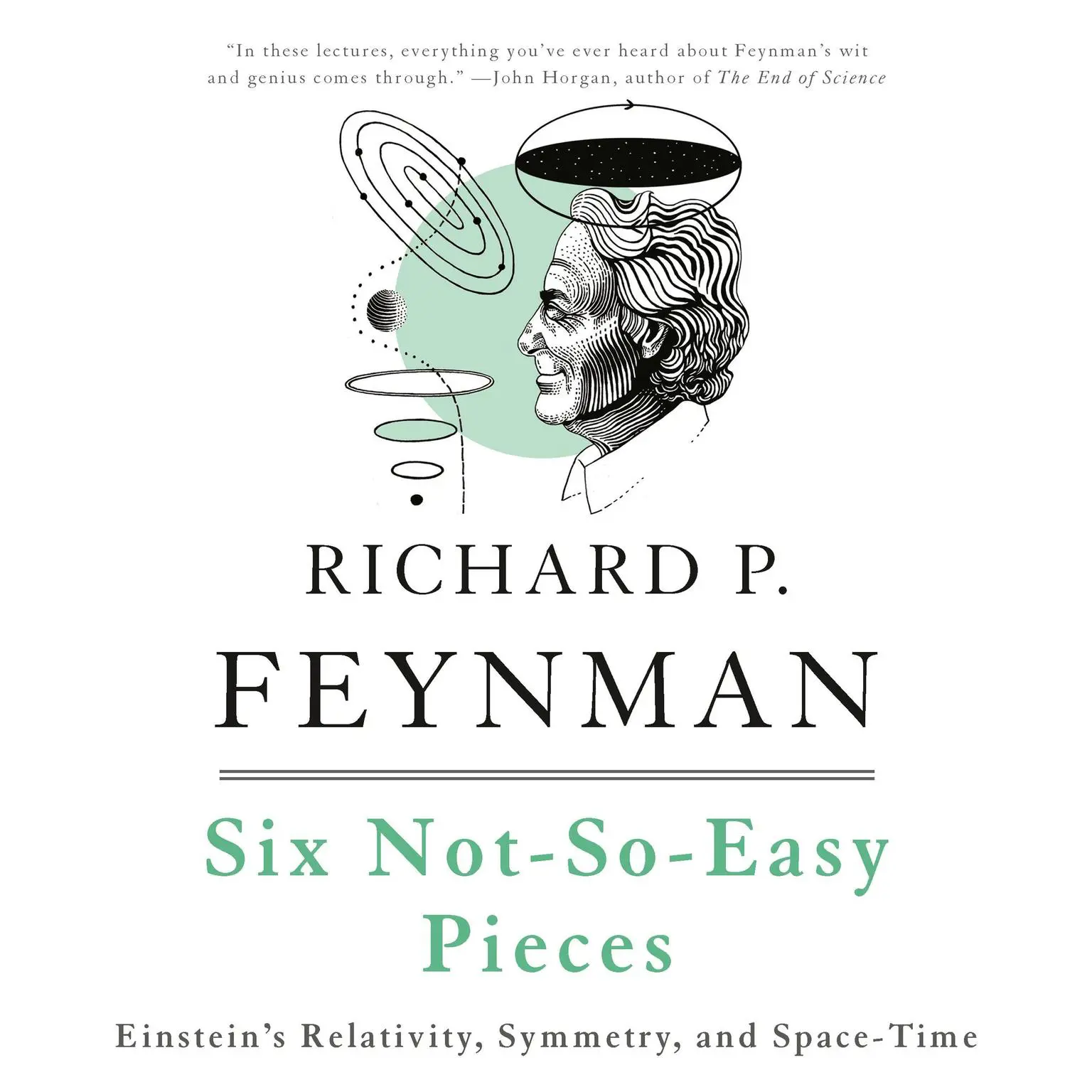
Six Not-So-Easy Pieces: Einstein's Relativity, Symmetry, and Space-Time Audiobook
Play Audiobook Sample
Read By: Richard P. Feynman
Publisher: Basic Books
Listen Time:
at 1.0x Speed
3.67 hours at 1.5x Speed
2.75 hours at 2.0x Speed
Release Date: July 2025
Format: Unabridged Audiobook
ISBN: 9781668653227
 (0.00) - 0 listener ratings
(0.00) - 0 listener ratings
Quick Stats About this Audiobook
Total Audiobook Chapters:
8
Longest Chapter Length:
62:45
minutes
Shortest Chapter Length:
35
seconds
Average Chapter Length:
40:50
minutes
Audiobooks by this Author:
9







Publisher Description
Learn about Einstein's theory of relativity from a physics Nobel laureate and "one of the greatest minds of the twentieth century" (New York Review of Books) in six memorable lessons
It was Richard Feynman's outrageous and scintillating method of teaching that earned him legendary status among students and professors of physics. From 1961 to 1963, Feynman delivered a series of lectures at the California Institute of Technology that revolutionized the teaching of physics. In Six Not-So-Easy Pieces, taken from these famous Lectures on Physics, Feynman delves into one of the most revolutionary discoveries in twentieth-century physics: Einstein's theory of relativity. The idea that the flow of time is not a constant, that the mass of an object depends on its velocity, and that the speed of light is a constant no matter what the motion of the observer, at first seemed shocking to scientists and laymen alike. But as Feynman shows, these tricky ideas are not merely dry principles of physics, but things of beauty and elegance.No one — not even Einstein himself — explained these difficult, anti-intuitive concepts more clearly, or with more verve and gusto, than Feynman. Filled with wonderful examples, Six Not-So-Easy Pieces is the ideal introduction to the fundamentals of physics by one of the most admired and accessible physicists of all time.
“There is no better explanation for the scientifically literate layman.” –Washington Post Book World
Download and start listening now!
"There is no better explanation for the scientifically literate layman."
— Washington Post Book World
Six Not-So-Easy Pieces Listener Reviews
Be the first to write a review about this audiobook!
About Richard P. Feynman
Richard P. Feynman (1918–1988) earned a BS from MIT and a PhD from Princeton. From 1942 to 1945, he assisted with the development of the atomic bomb. He then taught at Cornell and Caltech, where he contributed to the theories of superfluidity and quarks. He shared the 1965 Nobel Prize in Physics for work on the theory of quantum electrodynamics.