


 Play Audiobook Sample
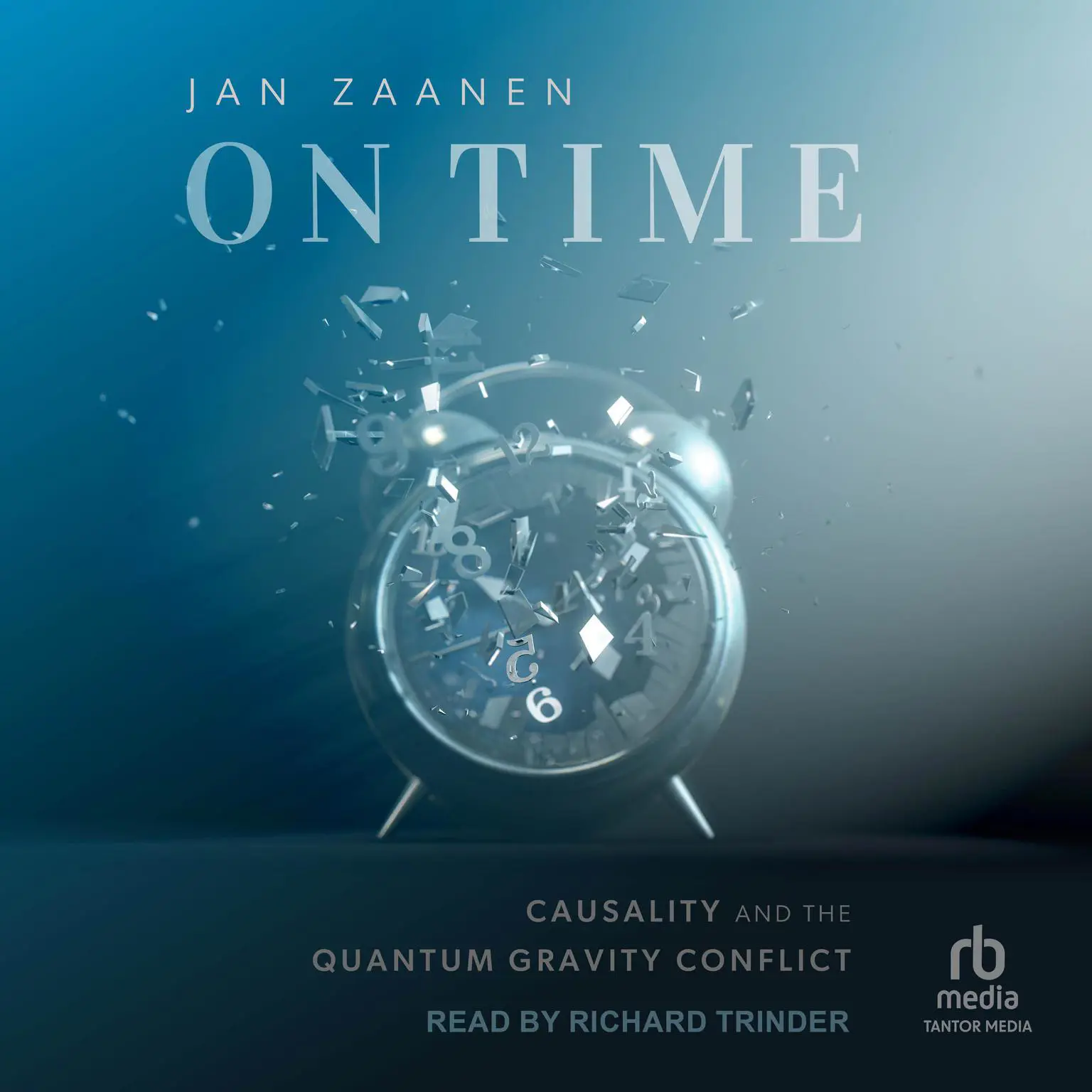
On Time: Causality and the Quantum Gravity Conflict Audiobook
Play Audiobook Sample
 (0.00) - 0 listener ratings
Quick Stats About this Audiobook
Total Audiobook Chapters:
Longest Chapter Length:
Shortest Chapter Length:
Average Chapter Length:
Audiobooks by this Author:
Publisher Description
This text revolves around a new and unusual view on the most fundamental puzzle of physics. It focusses on the key aspect that makes the role of the time dimension fundamentally different: causality. The implicit and intuitive way by which causality is usually taken for granted is just made explicit and less self-evident, shedding a new light on the gravity-quantum conflict. The case is made that gravity is a necessary condition for a causal universe. But upon turning to the "pure" unitary quantum physics explaining the nature of matter one is dealing with the strictly a-causal time expressed through the thermal quantum field theory machinery. When this a-causal microscopic and causal macroscopic world meet, one encounters the wavefunction collapse, that itself may be rooted in the quantum-gravity conflict. Modern ideas are discussed resting on eigenstate thermalization showing how this may lie eventually at the origin of irreversible thermodynamics. The case is anchored in the sophisticated modern mathematical machinery of both general relativity and quantum physics which is normally barely disseminated beyond the theoretical physics floors.
The book is unique in the regard that the consequences of this machinery are explained in an original, descriptive language conveying the conceptual consequences while avoiding mathematical technicalities.
Download and start listening now!
On Time Listener Reviews
Be the first to write a review about this audiobook!
About Jan Zaanen
Jan Zaanen is professor of theoretical physic, Institute of Physics, Leiden University, The Netherlands. He obtained his PhD in physics at Groningen University in the Netherlands, 1986. He was subsequently employed at the Max-Planck-Institute in Stuttgart, Germany, then moved in 1990 to Bell laboratories, Murray Hill, USA, as a long-term visitor of the theory group. He returned to Leiden University in the Netherlands in 1993 where he got appointed as full professor in theoretical physics in 2000. He became well known for his various groundbreaking discoveries in this field, honored by a Spinoza (“Dutch Nobel”) Prize, a fellowship of the Dutch Royal Academy, and visiting professorships at Stanford University, the Ecole Normale Superieur in Paris, and the Solvay Institute in Brussels.