


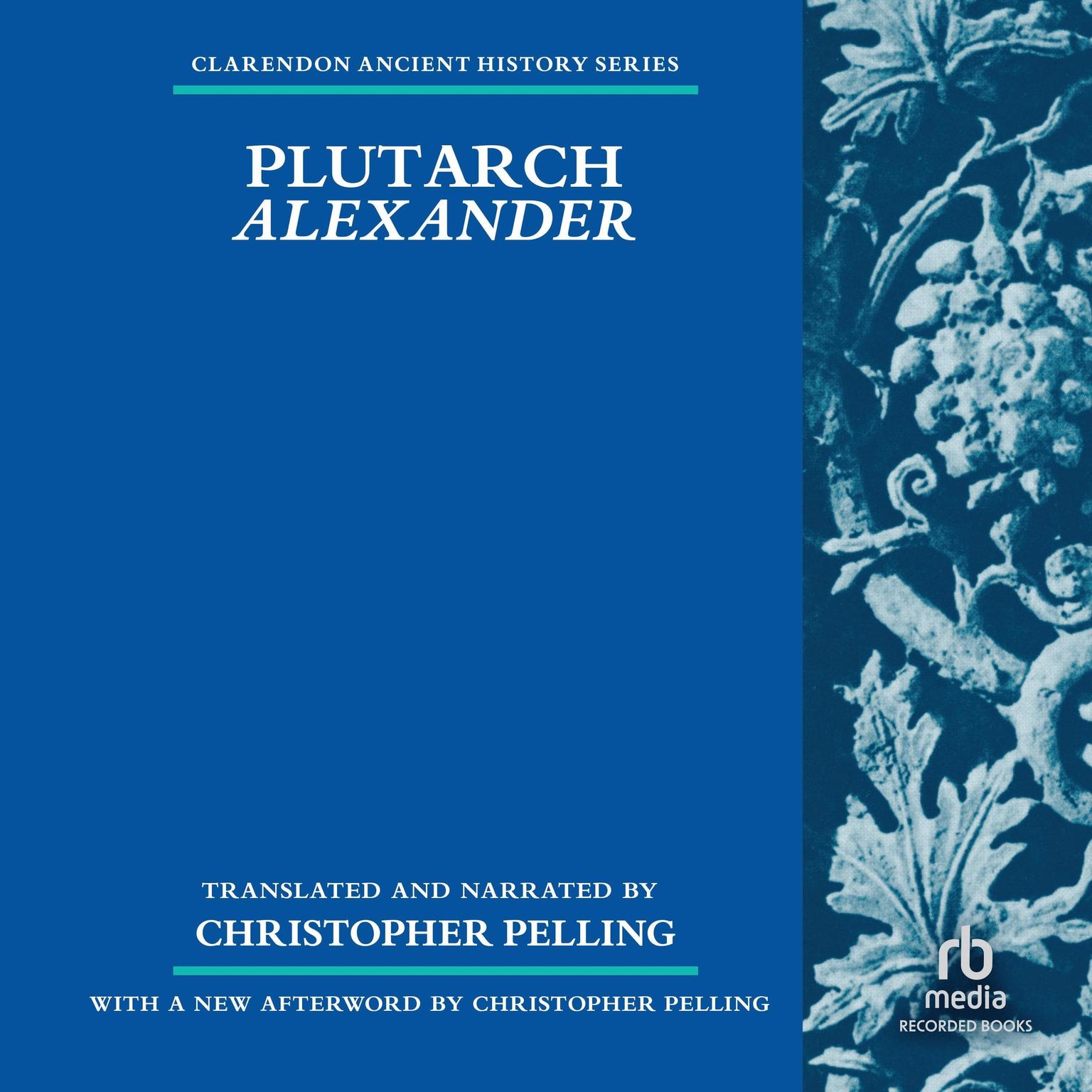
 Play Audiobook Sample
Alexander Audiobook
Play Audiobook Sample
 (0.00) - 0 listener ratings
Quick Stats About this Audiobook
Total Audiobook Chapters:
Longest Chapter Length:
Shortest Chapter Length:
Average Chapter Length:
Audiobooks by this Author:


Publisher Description
Plutarch: Alexander is the essential companion to Plutarch's Caesar, the life paired with Alexander in Plutarch's Parallel Lives. This new English version of Alexander is followed by an Afterword about Plutarch’s Parallel Lives by the translator, Christopher Pelling, Emeritus Regius Professor of Greek at Oxford University.
Plutarch composed his Lives in parallel pairs, and one choice must have seemed obvious: Alexander the Great and Julius Caesar, two dominating and colourful figures who each changed the world they lived in, Alexander by bringing down the Persian Empire and Caesar by winning the war which ended the Roman Republic and prepared for the rule of the emperors. It is their personalities that interested Plutarch most, as he uses ‘little things, a word or a jest or a playful moment’ to show what the men were really like. Alexander is seen to be a great soldier, full of spirit and ambition, gradually coarsened by his own successes until his final months at Babylon in a court full of superstition, terror, and dread; Caesar too is a brilliant figure, loved and admired by soldiers and people, letting nothing stand in his way until finally he lies dead, stricken down by his former friends on the Ides of March.
This dynamic audiobook is available in two parts, bringing together Plutarch: Alexander with its sister volume, Caesar. A new Afterword offers listeners a rare opportunity to explore the striking parallels and profound contrasts between these two titans of history.
Download and start listening now!
Alexander Listener Reviews
Be the first to write a review about this audiobook!
About Plutarch
Plutarch (c. AD 46–120) was a Greek historian, biographer, and essayist. For many years Plutarch served as one of the two priests at the temple of Apollo at Delphi. He actively participated in local affairs in the town of his birth, Chaeronea, in the Greek region known as Boeotia, and was also a magistrate, representing his home on various missions to foreign countries.
About Christopher Pelling
Christopher Pelling was Regius Professor emeritus of Greek at the University of Oxford and Student of Christ Church from 2003 to 2015. Before that he was fellow and praelector in classics at University College, Oxford from 1975 to 2003. He is a fellow of the British Academy, a fellow of the Learned Society of Wales, and an honorary fellow of University College, Oxford.